About $75M in memecoins trade on Robinhood Chain every day. $EVERYTHING holds the ten largest by volume in a single token, redeemable at any time for its share of the underlying basket.
THE EVERYTHING INDEX · ROBINHOOD CHAIN · THE OWNERS GET EVERYTHING · THE EVERYTHING INDEX · ROBINHOOD CHAIN · THE OWNERS GET EVERYTHING · THE EVERYTHING INDEX · ROBINHOOD CHAIN · THE OWNERS GET EVERYTHING · THE EVERYTHING INDEX · ROBINHOOD CHAIN · THE OWNERS GET EVERYTHING
The opportunity
The chain is a casino. Own the whole floor.
Hundreds of memecoins launch on Robinhood Chain, and dozens clear serious volume every single day. The leaders rotate constantly. Rather than guess the next one, hold the index that already owns the ones that matter.
$0MEMECOIN VOLUME / 24H
0COINS ABOVE $500K DAILY
0CONSTITUENTS IN THE INDEX
24/7THE VAULT NEVER SLEEPS
Mechanism
Four articles. That's the whole contract.
ARTICLE I
Every trade pays the machine.
Buying or selling $EVERYTHING on the DEX carries a 5% tax each way. There's no staking, no lockup, and nothing to claim — holding is the entire strategy.
ARTICLE II
Buys feed the vault. Sells pay the owners.
On a buy, the full 5% goes to the vault, so every purchase builds the index. On a sell, 3% is paid to THE OWNERS certificate holders in WETH — distributed weekly, pro-rata across 3,333 certificates — and 2% funds operations.
ARTICLE III
The vault buys the top 10.
The vault continuously acquires the chain's ten highest-volume memecoins, volume-weighted and capped at 25% each. As the market's leaders change, the index rebalances into them.
ARTICLE IV
Redeem for the basket.
Burn your $EVERYTHING to receive your pro-rata share of all ten coins. Redemption fees and accretive buybacks only add to the vault, so the basket backing each token grows over time — though its market value still moves with the coins it holds.
ARTICLE V · THE TAX CAN ONLY GO DOWN · THE SPLIT IS HARDCODED · READ THE CODE · ARTICLE V · THE TAX CAN ONLY GO DOWN · THE SPLIT IS HARDCODED · READ THE CODE · ARTICLE V · THE TAX CAN ONLY GO DOWN · THE SPLIT IS HARDCODED · READ THE CODE
The machine
Watch it run.
Every trade on the chain pays a toll. The toll buys the index. The index backs your token. Nobody has to do anything — it runs itself.
BUY → 5% TO THE VAULT → VAULT BUYS THE INDEX · SELL → 3% TO THE OWNERS, 2% OPS · BURN FOR YOUR BASKET, ANY TIME
The index
What it holds right now.
Nothing here is hand-picked — the table discovers every major pool on the chain, aggregates them by token, screens them, and weights the top ten by real volume, capped at 25%. It re-runs on every load: this is Robinhood Chain as you look at it.
$EVERYTHING · CONSTITUENTSSYNCING…
TOP 10 BY VOLUMEREAL DEX LIQUIDITY ≥ $50KVOL ≥ $250K/DAY12H+ TRADING HISTORYLAUNCH-PHASE FLOORS — THEY RATCHET UP AS THE CHAIN AGESAUTO-EJECT ON RUG SIGNALS
The index holds the top ten by volume among names clearing the floors. On a chain this young the leaders are often days old, so the floors are sanity checks — real liquidity, real volume, a full day of trading — not a maturity bar that would empty the basket; they tighten as the chain ages. Names still inside their first hours show above as queued, with their entry time. Why ten → On-chain, new names enter as they clear the screen, bought by the day's inflows — nothing is sold. Weights hard-reset weekly, and only if the basket has drifted more than 15% from target. A constituent can be ejected at any time on rug signals.
The model
Rules a trader can't run by hand.
The index isn't a vibe. It's a screen that runs every day on live chain data — the kind of bookkeeping no one does at 3am chasing a candle.
SCREEN
Top ten by volume, above real floors.
The index ranks the chain's memecoins by volume and holds the top ten among names clearing $250k daily volume, $50k of real DEX liquidity, and 12+ hours of trading history. The floors keep launch-hour traps and empty books out — several of the chain's biggest "volume leaders" trade on bonding curves with zero liquidity, and the vault will never touch them. Floors ratchet up as the chain matures, toward the long-run screen the research assumes. A launch-hour coin can't enter, whatever its volume.
WEIGHT
Weighted by real volume, capped at 25%.
Positions follow 14-day average volume — where the money actually is — with a hard 25% cap so no single coin can dominate the basket. Entry uses a +20% hysteresis band to avoid churning in and out on noise.
REBALANCE
Weekly reset. Daily inflow steering.
The rebalance date is weekly — and it only trades if the basket has drifted more than 15% from target. Between resets, each day's inflows top up whatever is underweight, with no forced selling. Constituents auto-eject at any time on rug signals: volume collapse, an 85% drawdown, or an LP pull.
88%OF THE LEADING COIN'S UPSIDE CAPTURED BY THE INDEX*
−10%INDEX MAX DRAWDOWN VS −29% FOR THAT COIN ALONE*
RulesREBALANCED FROM ON-CHAIN DATA NO DISCRETION
* Backtested on the only window that exists — Robinhood Chain is roughly two weeks old, so the eligible track record is 8 days (Jul 6–13, 2026). Short, and inside a chain-wide rally. The point isn't the raw return — it's that a screened, capped, volume-weighted basket took one-third the drawdown of holding the single hottest coin. Past performance is not indicative of future results.
Why exactly ten names, and why rotate on a weekly clock? We ran the numbers on 200 days of Solana memecoin data — the only dataset deep enough — and found the risk-reduction plateau lands near ten. Read the research note →
The floor
Backed by the basket. Redeemable at any time.
Redeem in kind.
Burn your tokens and receive your pro-rata share of every constituent, sent straight to your wallet. There's no counterparty and no queue — the contract settles it directly.
Arbitrage anchors the price.
If the token trades below the vault's value per token, anyone can buy it, redeem the basket, and keep the difference. That keeps the price tied to what the vault actually holds.
Exits leave value behind.
A 2% redemption fee stays in the vault. Each exit leaves a little more basket backing every remaining token.
Buybacks only when accretive.
When the token trades under 95% of vault value, the vault buys back and burns — but only while doing so adds value for the holders who stay.
GREEN: BASKET UNITS BEHIND EACH TOKEN — ONLY ADDED TO. ITS DOLLAR VALUE STILL MOVES WITH THE COINS.
Proof
Live from the chain.
The index reads Robinhood Chain directly, and the mechanism has already run on it. Every number below is pulled live as the page loads.
—24H VOLUME TRACKED ACROSS CONSTITUENTS
—CONSTITUENTS LIVE MEETING CRITERIA
—CHAIN BLOCK READ IN REAL TIME
—LAST SYNC THIS PAGE
✓ MECHANISM EXECUTED ON-CHAIN — tax split, vault index-buy, and burn-to-redeem all ran against live pools on Robinhood Chain.
View the test contract →
Terms
Simple. Immutable. Verifiable.
1,000,000,000
fixed supply — no mint function exists. 80% liquidity · 8% smart-money airdrop · 7% to the owners · 4% operations · 1% referral reserve, all declared. NO PRESALE.
5% / 5%
tax each way. Buys build the basket in full. Sells pay the owners — 3% to certificate holders in WETH, 2% to operations. Over a round-trip, half of all tax backs the coins your tokens redeem for and nearly a third goes back to the owners. Written into the contract. HARDCODED.
Tax only goes ↓
the contract exposes a single lever — lowerTax() — which can reduce the tax but never raise it. ON-CHAIN.
Basket-backed
redeemable at any time for its share of the underlying ten coins. Arbitrage keeps the price tied to vault value. VERIFIABLE.
THE OWNERS GET EVERYTHING · 3333 CERTIFICATES · MINT 0.00123 ETH · EVERY CERTIFICATE IS AN AIRDROP TICKET · THE OWNERS GET EVERYTHING · 3333 CERTIFICATES · MINT 0.00123 ETH · EVERY CERTIFICATE IS AN AIRDROP TICKET · THE OWNERS GET EVERYTHING · 3333 CERTIFICATES · MINT 0.00123 ETH
The certificates
THE OWNERS. The owners get everything.
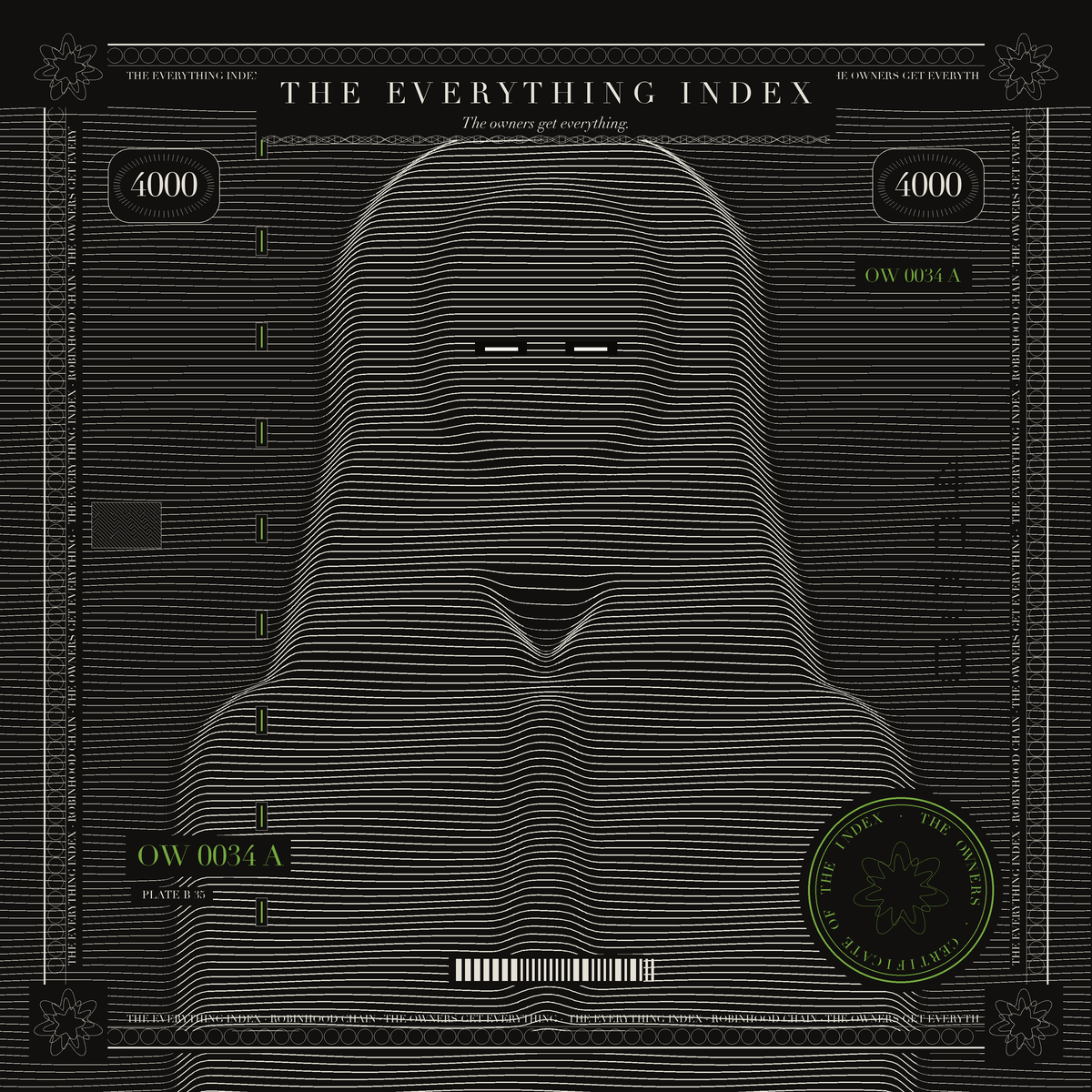
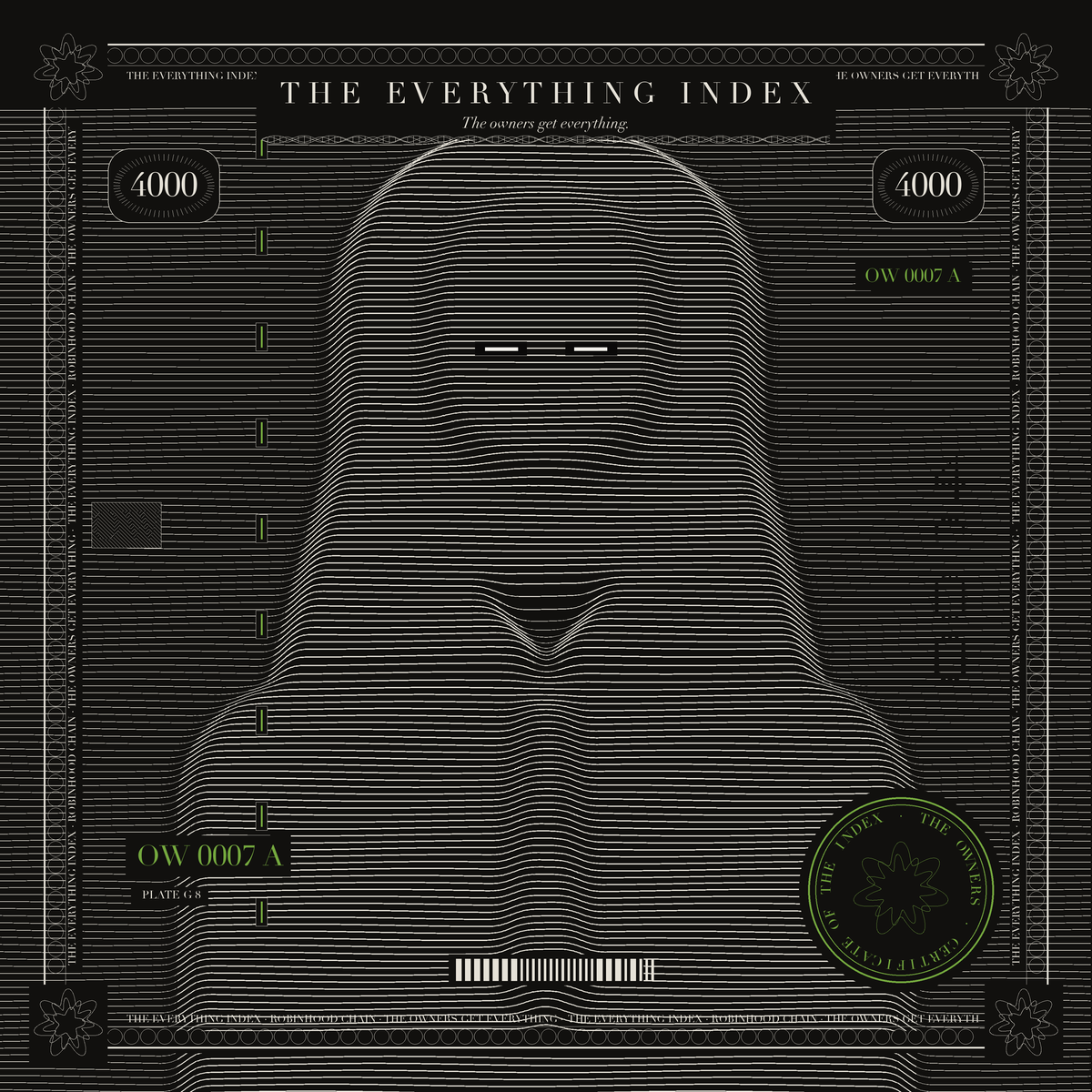
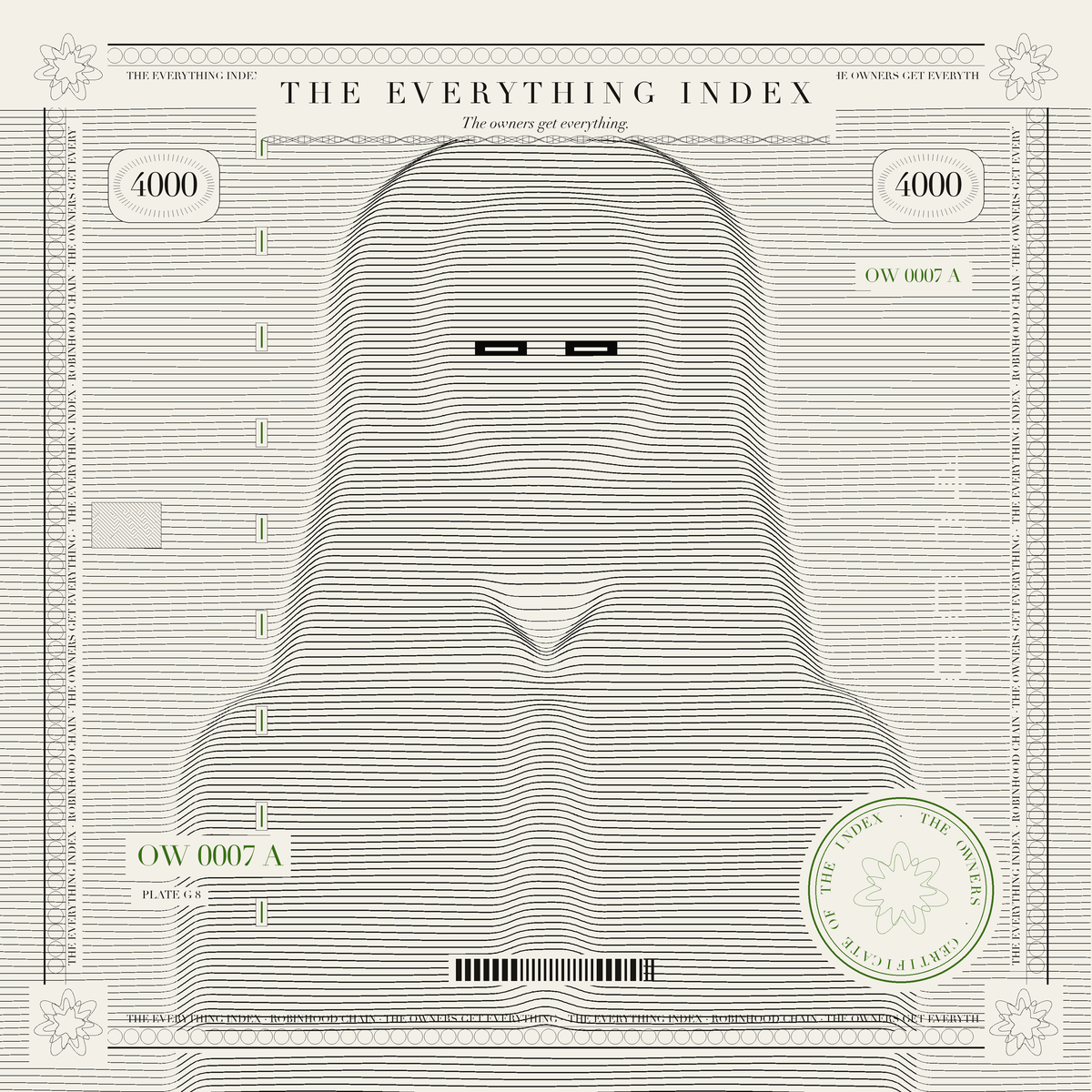
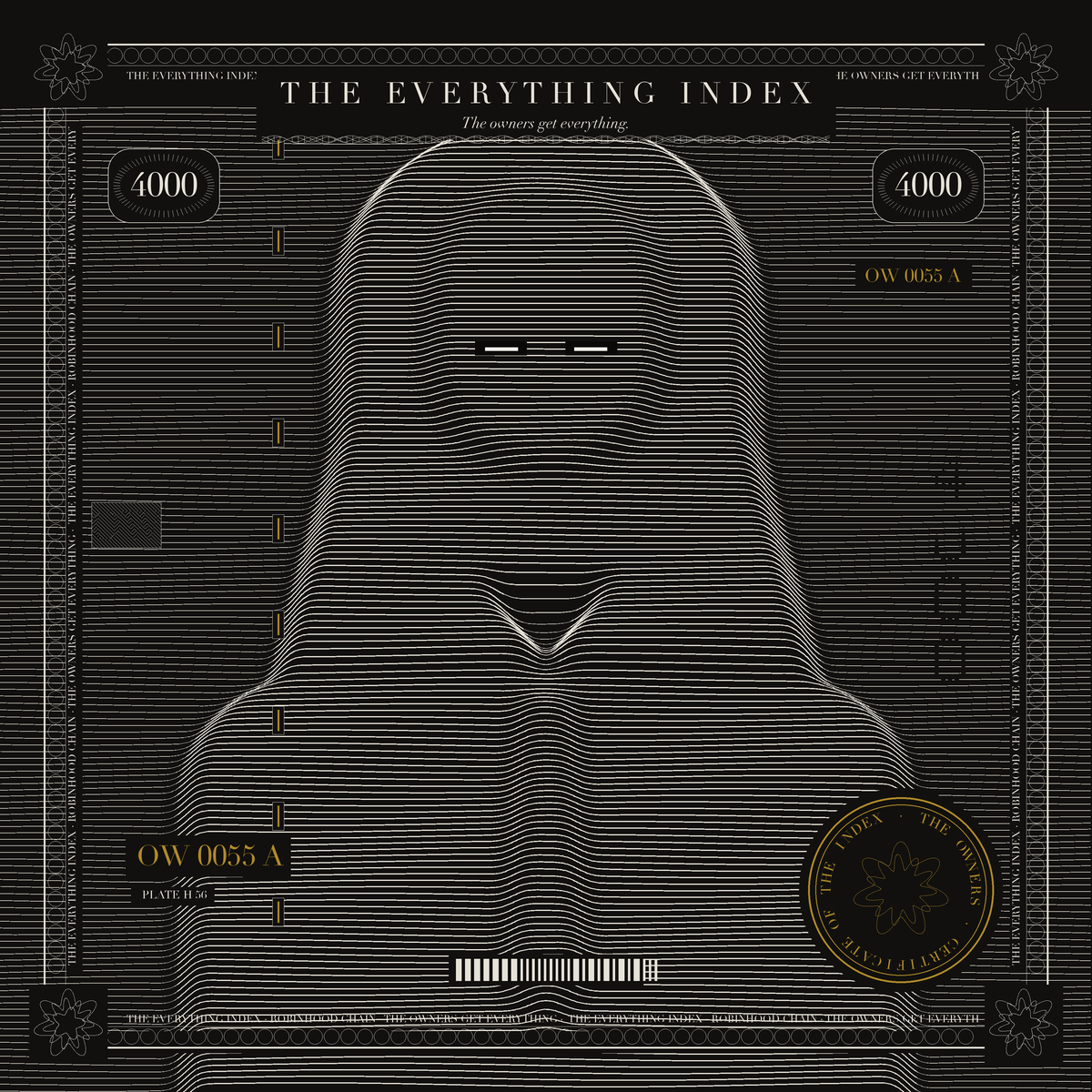
3,333 certificates engraved like banknotes — displacement engraving, security thread, microtext on every rule, double serial, EURion rings. Every certificate carries unique lattice frequencies and a plate mark for life. Mint: 0.00123 ETH, max 2 per wallet.
A certificate pays three ways: 21,000 $EVERYTHING airdropped up front, 3% of every sell on the index paid to certificate holders in WETH — weekly, pro-rata across 3,333 — and a resale price of its own on OpenSea. You're not making a single bet. See the full economics →
AIRDROP — 15% OF SUPPLY AT LAUNCH, SENT DIRECTLY TO WALLETS. NO CLAIM STEP, NO GAS WAR. 8% TO THE CHAIN'S PROVEN HANDS — SCORED ON-CHAIN BY SIZE (√-WEIGHTED), CONVICTION THROUGH DRAWDOWNS, MULTI-COIN BONUS, CAPPED 0.5% EACH, BOTS & CONTRACTS EXCLUDED. WE RAN IT: 1,393 WALLETS ALREADY QUALIFY — SEE THE ANALYSIS → 7% TO THE OWNERS, PRO-RATA — 21,000 PER CERTIFICATE. HOLD ONE AT SNAPSHOT AND THE ALLOCATION FINDS YOU. +2,000 PER CERTIFICATE YOU REFER · +1,000 FOR THE OWNER YOU BRING — 1% RESERVE, NO CAP. WHAT IT DOESN'T PAY OUT IS BURNED.
This is a volatile crypto asset. The price of $EVERYTHING can fall sharply, including to zero. Commit only what you can afford to lose entirely.
The floor is a basket, not a dollar guarantee. The vault holds memecoins. If those coins fall, the value you can redeem falls with them. What only grows is the basket backing per token — not its price in dollars.
No returns are promised. Nothing here is investment advice, and $EVERYTHING is not a security, share, or fund interest. It is not offered where doing so would be unlawful.
Smart contracts carry risk. Bugs, exploits, oracle failures, and chain outages can cause partial or total loss. The contracts are published for anyone to review — they are not audited. Read them before you interact.
The index can change. Constituents are chosen by on-chain rules and can be added, reweighted, or ejected. Any constituent's liquidity can thin or disappear.
Certificates are collectibles. THE OWNERS grant an airdrop allocation and carry no equity, dividend, or promise of profit. You are responsible for your own taxes and compliance.
$EVERYTHING and THE OWNERS are experimental on-chain products on Robinhood Chain. By interacting with the contracts you accept that you do so at your own risk, that no team member can reverse an on-chain transaction, and that regulatory treatment of these assets may change. Do your own research.